Yesterday evening was the last of my four week cake decorating classes that I’d been taking this past month, and we were asked to design and decorate our own cakes. For my final project, I created this rose cake. I can’t call it perfect, but as an amateur, I’d say this is one of the best decorating jobs I’ve personally ever done. While I love baking, the decorating aspect of cakes and cupcakes has always been a struggle with hit or miss results. Taking this cake decorating course helped me learn some great techniques, which will hopefully lead to better decorating results in my future baking endeavors!
I’m especially thankful for Dan, who encouraged me to take the classes, and who has been my photographer to document my creations along the way, as well as my taste tester. :)Â I feel very lucky to have a husband who is so understanding and supportive of my various creative hobbies and interests!
As you can observe in the video, Mio has learned how to climb up onto the coffee table. She’s done it at least a dozen times since yesterday. No matter how many times I pull her off or try to navigate her away, she goes right back to it.
I’d heard toddlers usually begin climbing between 18 to 24 months, but Mio has once again surprised us with her advanced athletic abilities. And she looks so pleased with herself every time, too. Heaven help us….
We enjoyed some gorgeous weather this past weekend, with temperatures reaching the 80s on Saturday! We had planned to go the Cherry Blossom Festival in the city, but at the last minute decided against it, since navigating the crowds in the hot weather with a toddler didn’t seem so relaxing. Instead, we stayed in the local area and spent our Saturday on more Mio-centric activities.
Our first stop was the pet store! We stopped by while taking a walk to the farmer’s market, because Mio loves to go to the pet store to see all the animals. Weekends are especially fun to go, because there are often kitties there for adoption, as well as all the dogs that customers bring in to be groomed.
Mio looking at the birds.
Amazed at all the birds.
Watching a snake.
Look at all the fishies!
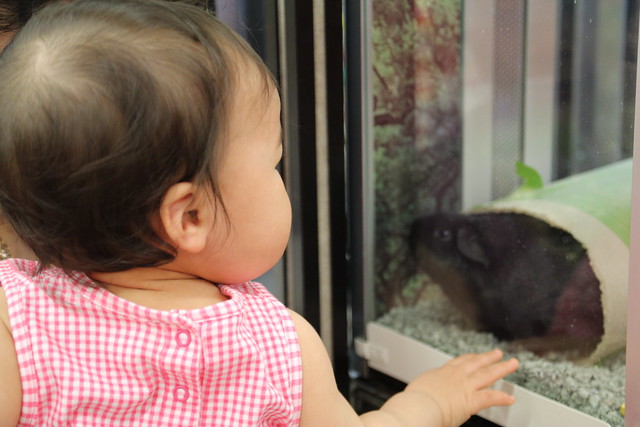
Also got to see a guinea pig...
...and some mice.
Dan bought Mio and I these lovely tulips at the farmer’s market… so beautiful! 🙂
Thanks hubby!
Back at the house, ready to go out again.
In the afternoon, we drove over to North Berkeley to visit Totland for the first time! I’d heard that it’s a popular for local mommies and kids to play, so we decided to check it out!
Scrunchy-faced smiles on the swing.
Mio and I in the sandlot.
Sipping away! Gotta stay hydrated!
Mio made a friend on the playground. Her mom happened to be Japanese, too!
Scooting around...
...with some help from Mama.
Mio is distracted by the older kids around the playground.
Taking a break for snack time!
Mio with a mouthful of fresh fruit.
Back on the swing.
Stylin' in shades! Thank you Matt for the baby sunglasses!
Dan and I couldn't stop laughing at how silly she looked in them!
After a couple hours of playground fun at Totland, we worked up quite an appetite! I’d been wanting some Filipino food, so we drove all the way up to Vallejo to try Max’s of Manila.
Ready to eat!
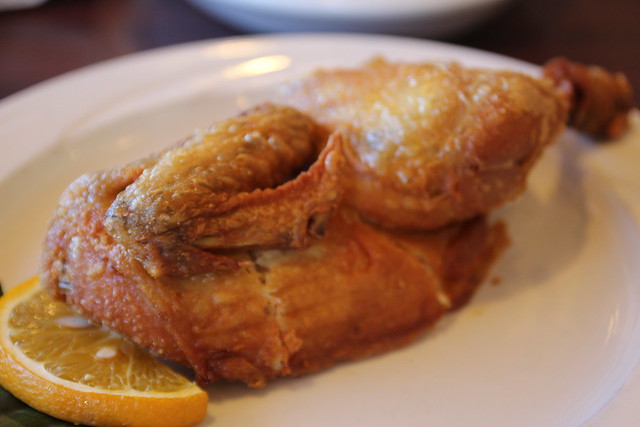
Filipino-style fried chicken. So amazing.
My first time trying pancit canton... and I am hooked!
They gave us a ton of garlic rice, which was also very tasty!
We also had some lumpia ubod, but Dan and I devoured it before we could take a picture…Â it was yummy, too!
Mio was really happy with a lemon she snagged from my plate.
Her reaction upon having a taste, however, was priceless. She's had it before, but she always forgets how sour it is.
Mio was in such a good mood that day, especially during dinner, which is rare because she usually gets cranky in the evening.
Sweet girl brings so much joy to our hearts.
We hope this awesome weather keeps up! 🙂 It’s starting to feel like summer!
We’ve been teaching Mio some basic ASL as “baby sign language” to help her communicate to us what she has yet to be able to say verbally. We started by signing only a couple signs to her six months ago, and for the first few months, it felt like she wasn’t comprehending much because she’d just respond with a blank stare. But all the consistency paid off, as she’s really been picking up the words in the past two months. She now knows how to sign “milk,” “more/again,” “eat,” “bath,” “shoes,” and “all done.” She’s also starting to understand the signs for “dog,” “hurt,” and “delicious,” but doesn’t sign them quite as readily yet. I’ve been trying to stay ahead of her by learning more signs myself to teach her, but my brain is not the absorbent language sponge it used to be! But I’m trying my darnedest to remember more and use signs as much as I can in conversations with Mio.
I was randomly browsing the web when I came across a very interesting article that explains the benefits of teaching and using baby sign language in a bilingual household. When each parent uses the sign and says the words in their respective language, sign language becomes a “language bridge” between the two languages to connect the words together for the child to understand that they have the same meaning. The article explains it best:
Excerpted from The Baby Signs® Program: A Helpful Tool in Bilingual Settings
Linda Acredolo, Ph.D. & Susan Goodwyn, Ph,.D.,
Co-Founders, Baby Signs, Inc.
As more and more parents learn the value of exposing their children to second and even third languages early in life, the number of babies being raised in “bilingual homes†is rapidly increasing. Just what does this mean? In many cases it means that one parent speaks one language to the child while the other parent speaks a second. In other cases, both parents may speak the same language to the child while a trusted caregiver (grandmother or nanny) speaks another.
So, what happens if we add signing to the mix? Will it just add to the child’s confusion?
The answer is a strong and resounding “No!†The truth is that, no matter what form bilingual input takes, adding signing to the mix actually makes the child’s job easier, not harder. Here’s why.
When children first start learning about language, they quite naturally look for one-to-one correspondences between words and the objects (or actions) they label. For example, babies in an English-only environment, upon hearing the word “milk†in the presence of white stuff in their bottle, will eventually learn to associate the two together:
CHILD: “Hmmm….I get it! The white stuff in my bottle = ‘milk’“
However, life gets more complicated in a bilingual household. In this case babies consistently hear two words in association with the white stuff in their bottle, a situation which can be very confusing.
CHILD: “Hmmm….Sometimes I hear “milk,†sometimes “leche.†What’s going on?â€
Clearly, what children hearing two languages need to figure out is that both words are equally important labels for milk. And that’s where signing comes to the rescue. By adding a sign to the mix so that the same visual symbol (sign) accompanies both words (“milk†and “lecheâ€), parents make the job of connecting the object with the meanings of both words much easier for babies. In other words, when the baby hears “leche†paired with sign and then also hears “milk†paired with the sign, the pieces fall into place:
CHILD: “Aha! These words mean the same thing!
In summary, rather than confusing your bilingual child, signs will help smooth the road to understanding and speaking both languages.
Of course, signing has another advantage in bilingual settings, especially in child care classrooms where teachers and families speak different languages: The signs provide a common language so that toddlers who are learning the family language can still make themselves understood. Just such a situation exists at the Center for Child and Family Studies at the University of California, Davis, where graduate students from all over the world routinely enroll their infants and toddlers. In the 18 years since the Baby Signs® Program was first introduced, teachers and parents alike have been amazed at how much more smoothly daily life in the classroom proceeds, with data specifically showing that the teachers are more responsive to the needs of the children. In addition, the signs have enabled children who speak different languages to communicate with each other. In one case, for example, a toddler from Israel and a toddler from Taiwan were observed reading a picture book together—with the first girl turning the pages and pointing at objects while the second girl made the appropriate signs!
Bottom line? Signing is clearly a boon to children facing the challenge of hearing multiple languages, whether at home or in the classroom.
Very cool! And the most awesome part for us is that we had already unconsciously been practicing this — Dan always uses the English words while signing, while I always use the Japanese word for it while using the same sign. For example, Dan says “more,” while I say “motto,” when we use the ASL sign for “more,” and Mio has been responding to the word in both languages with the same sign. We even have it on video from a couple weeks ago!
With this new knowledge and perspective on baby sign language, we are more convinced than ever that it is a valuable tool for the development of Mio’s communication skills and our efforts to raise her to become a bilingual speaker.
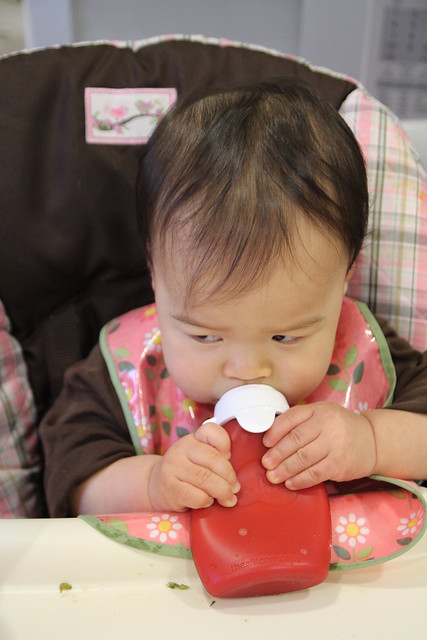
I love finding new and innovative products for babies and kids (remember the Yoomi bottle?), so I wanted to share this neat product I recently discovered — the Sili Squeeze.
The Sili Squeeze actually just hit the market last fall, and was developed out of the owner’s desire to feed her growing baby nutritious food on the go whether in the car seat, stroller, or shopping cart. The squeeze is “mommy hands freeâ€, so your little ones can squeeze themselves silly, without the mess and wastefulness of a disposable squeeze.
It can be used by youngsters as little as six months old, all the way up until they are much older kids, to enjoy snacks like applesauce and smoothies. They are sold with two spout options — one which is spill-proof and has some resistance, for babies and toddlers, so that they don’t make a mess, and another with a resistance-free nipple spout that is more free-flowing for kids who are beyond the messy-eating stage. They come with caps, so that the contents will not spill out when not in use.
The Sili Squeeze is great for when you’re on the go and need a mess-free snack to take with you, but I use it a lot at home, too! Now that it’s getting warmer, maybe I’ll make some fruit yogurt smoothies for Mio to enjoy. I think this pouch is a great investment, and hope to get years of good use out of it! 🙂