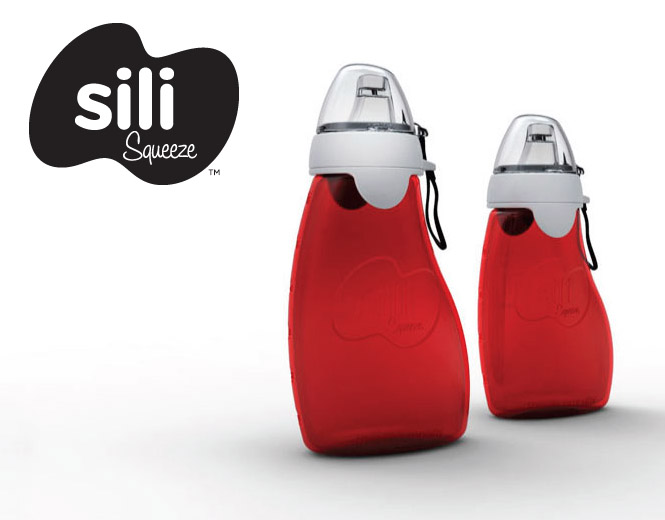
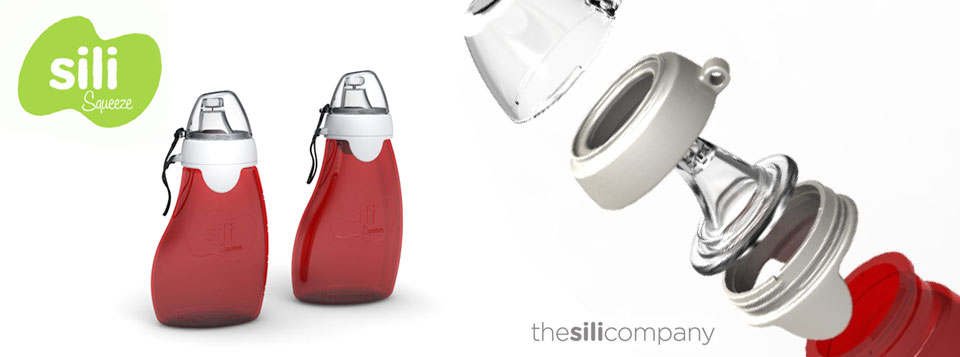
I love finding new and innovative products for babies and kids (remember the Yoomi bottle?), so I wanted to share this neat product I recently discovered — the Sili Squeeze.
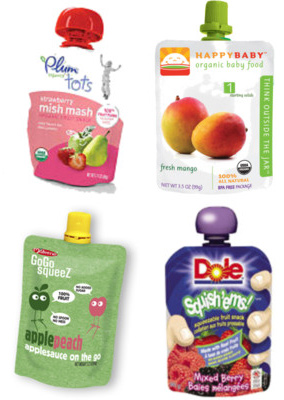
The Sili Squeeze actually just hit the market last fall, and was developed out of the owner’s desire to feed her growing baby nutritious food on the go whether in the car seat, stroller, or shopping cart. The squeeze is “mommy hands freeâ€, so your little ones can squeeze themselves silly, without the mess and wastefulness of a disposable squeeze.
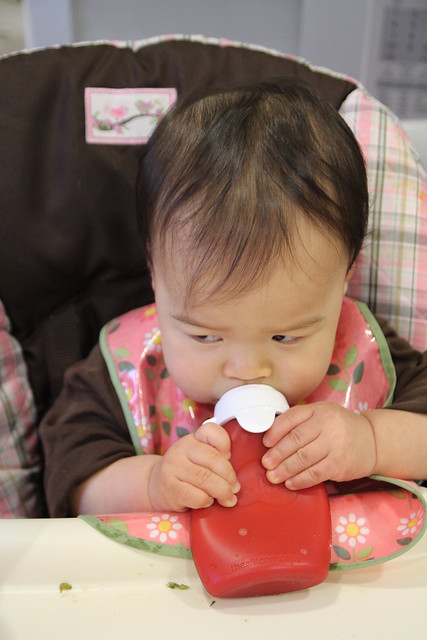
It can be used by youngsters as little as six months old, all the way up until they are much older kids, to enjoy snacks like applesauce and smoothies. They are sold with two spout options — one which is spill-proof and has some resistance, for babies and toddlers, so that they don’t make a mess, and another with a resistance-free nipple spout that is more free-flowing for kids who are beyond the messy-eating stage. They come with caps, so that the contents will not spill out when not in use.
The Sili Squeeze is great for when you’re on the go and need a mess-free snack to take with you, but I use it a lot at home, too! Now that it’s getting warmer, maybe I’ll make some fruit yogurt smoothies for Mio to enjoy. I think this pouch is a great investment, and hope to get years of good use out of it! 🙂
As we mentioned a couple weeks ago, Mio is quickly outgrowing her infant car seat and accompanying Snap n’ Go, and although we got her a new stroller, we still needed to find a larger car seat for her. Since we found her outgrowing the infant car seat before six months had even passed, we really wanted to invest in a car seat that would last us a few years so that we would not constantly have to upgrade to more car seats as Mio grows since they can be pretty darn expensive!
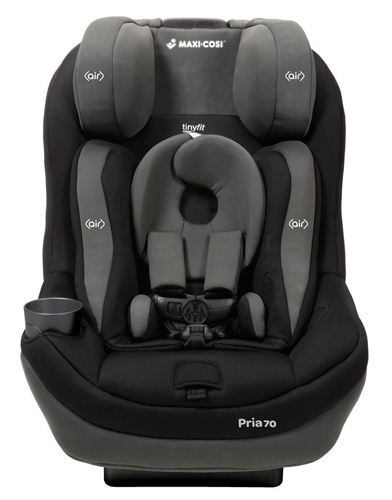
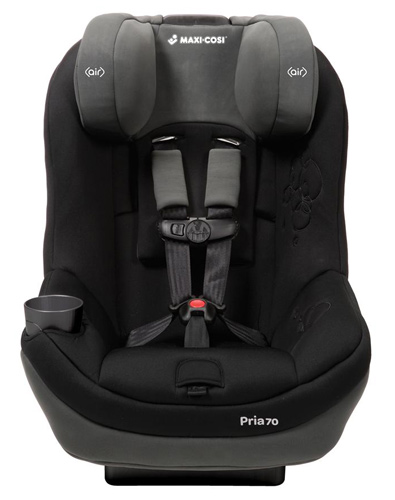
I didn’t do nearly as much research as I did for the stroller, as there are comparatively fewer options when it comes to convertible toddler car seats. While I at first considered either of the very popular Britax Boulevard or Britax Marathon, I found myself drawn to one that I’d seen at Buy Buy Baby when we had gone to take a look at the Quinny Zapp Xtra — the Maxi-Cosi Pria 70. Maxi-Cosi is a brand under the same umbrella company (Dorel Juvenile Group) as Quinny, so their products boast the same sophisticated design and great quality that attracted us to the Zapp Xtra.
The great thing about this convertible car seat is that it can fit smaller babies in it with its TinyFit system, starting from only 4 lbs to 22 lbs.
Later, you can easily remove the TinyFit system for the car seat to fit a larger toddler, rear-facing from 18 to 40 lbs. When your toddler is ready, you can turn the seat around and it will comfortably fit children up to 70 lbs forward-facing.
Additionally, those nifty parts that have the <air> symbols are Air Protect advanced side impact protection, which is being integrated into more and more car seats these days. Air Protect is a new technology meant to soften the blow to a baby’s head in a side-impact crash — it’s essentially a constantly deployed airbag, or a super soft pillow capable of absorbing the a large impact and effectively extending the amount of time a child’s head has to stop in an impact situation. While I hope we never get into a car accident with Mio in the car, it’s nice to have that assurance and peace of mind that she’ll be in a seat with the best protective technology on the market (especially when you’re like me and not the best driver on the road).
More great features: the straps are very easy to adjust, and the clips are sturdy yet easy easy for adults to unfasten. Height is adjustable with the sliding headrest, and the seat is thickly padded for extra comfort and snug fit. The fabric on the Pria 70 is very smooth and almost slick, making it easy to quickly wipe away sweat and any spills, and won’t overheat your child in hot weather. I also read that Maxi-Cosi’s seats generally rate cleaner on the toxic chemicals list than other companies’ convertible car seats. It even has a cup holder! The Maxi-Cosi Pria 70 is still a very new convertible car seat on the market, as it only just became available in August, but it seems like car seat experts agree that it is a revolutionary seat in terms of fit, versatility, and safety.
Ch-ch-ch-changes! The car seat and Snap-n-Go stroller that we got from Baby Trend earlier this year has been serving us well for the past few months since Mio’s birth, but we had been setting our sights on getting a big girl stroller for Mio for a while now. Although the car seat claims that it can hold up to 30 lbs of weight (and Mio is still under 20 lbs), she is already just barely fitting in it mass-wise. We’re pretty certain that in a month of two, she’ll be too large for it. So, being the prepared Super Mom — or rather, control freak worrywart — that I am, I started doing my usual extensive research on virtually every stroller out there to figure out what would be the best fit for our little family.
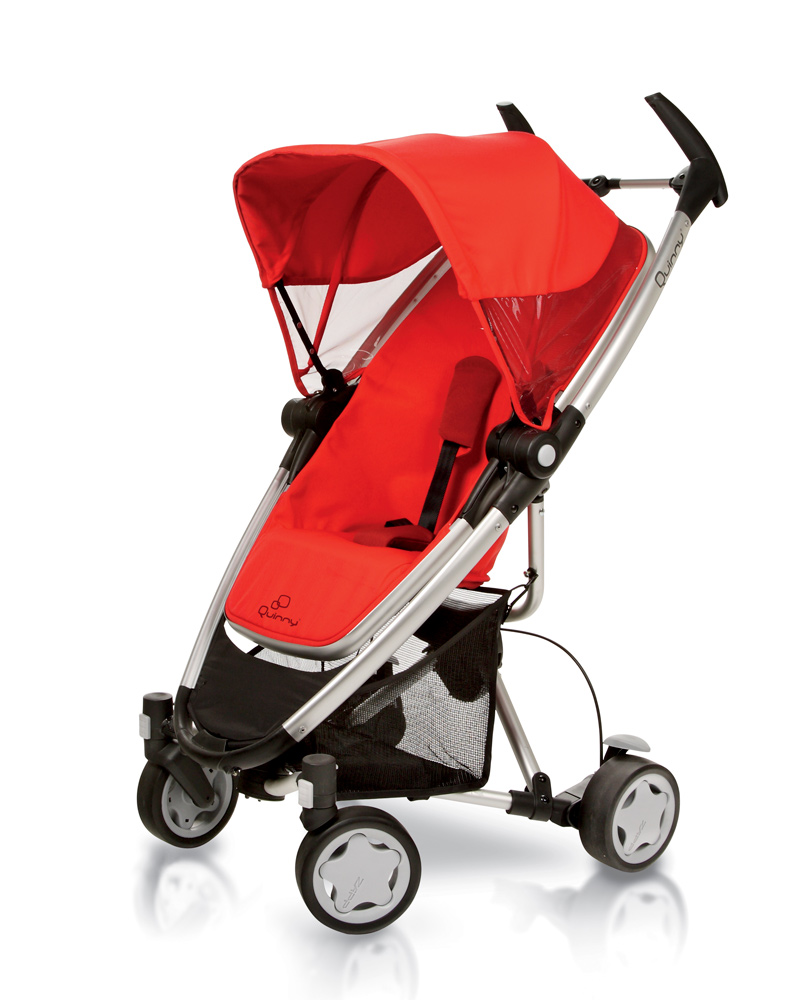
The Quinny Zapp Xtra intrigued me and was a top contender in my mind from the beginning. It was actually the original Quinny Zapp that I initially considered, due to the fact that when folded up, it is the world’s most compact stroller. (Having a stroller with a small footprint is important to us, since we wanted to be able to store it in our small duplex unit when necessary, and keep it in the trunk of our cute little Honda Fit for outings.) It has a sleek design and is originally from the UK. There were some major disadvantages to it, though — it was unable to recline, the sun canopy was not that big, and it could only face forward. That’s when I stumbled upon the updated version, the Quinny Zapp Xtra, which just released in the US market in March. The Zapp Xtra solves all those issues of its predecessor with a new seat that reclines to three positions, has an impressive sun canopy, and the ability to be flipped to be either forward-facing or rear-facing. I had never really thought about the option of having a rear-facing stroller, but I figured it’s nice to have the option, especially when the baby is still young. (I also recently read this article that away-facing strollers stress babies out. While the study’s suggestion that life in such strollers is “emotionally impoverished”and lead to “stressed babies [that] become anxious adults” seems a little extreme, the observation that parents tend to talk more to their babies when they are facing towards them definitely makes sense.)
The drawback to the Zapp Xtra is that the new-and-improved removable seat now adds a bit more weight and takes up a little more space than the original Zapp pushchair, but the frame itself is still just as compact. It can actually be used from birth (with a minimum weight of 5 lbs) to around 4-5 years old, with a maximum weight capacity of 50 lbs. The Zapp Xtra also comes with adapters so that you can attach a Maxi-Cosi Mico infant car seat to the frame as well, so we may get rid of our Baby Trend system and just go that route for any future babies. It’s great for travel (apparently, it’s so lightweight you can even take it on the plane as a carryon), and all around just seems like the perfect urban stroller.
We’ve been taking Mio outside the house a lot more lately, and I have been on the lookout for a good bottle warming system. Although Mio is solely on breast milk these days and we haven’t had to supplement with formula since the first couple weeks after she was born, I have been making sure to pump and bottle-feed her the expressed breast milk about half the time, so that she can be used to the bottle so that other people can feed her when I’m not available. (Don’t get me wrong — I do think nursing directly is the best way to feed the baby and I still do so over half the time — but I’ve heard horror stories of babies only wanting the breast and refusing bottles, and with me going back to work in mid-July, I would like to avoid that hurdle altogether.) We’ve been using Dr. Brown’s bottles at home, which have been awesome — they truly seem to be the best with their internal vent system that reduces feeding problems like colic. They do have a few more parts to wash and assemble each time compared to other bottles, but that has not bothered me and I really believe it’s worth it to prevent air bubbles that can oxidize the milk and deteriorate the nutrients in the milk.
When we go out, we usually take a bottle or two with us because we’ll often find ourselves in a place where it wouldn’t be so appropriate — or I’m not comfortable — to nurse in public. We put the bottle(s) in an insulated bottle holder and try to find a way to warm up the milk via hot water if it is too cold, but honestly, it is a hassle to find a way to warm the cold bottle every time Mio gets hungry while we’re out. I’m especially nervous about feeding Mio during my 6-hour flight to DC next week, along with all the time we’ll have to spend at the airports. And so the search for the perfect bottle warmer began. But all the ones that have traditionally been sold in the US market have had mixed reviews — there are ones that plug into the car, others that use a gel heat activation system surrounding the bottle, and others that are just plain bulky thermoses. All of them seemed to have disadvantages that seemed to outweigh the benefits. Virtually all of them take 10-15 minutes to warm up a bottle, which can be a long time when you have a hungry crying baby. I told myself that there had to be a more convenient solution out there that would warm up a bottle quickly without needing the help of plugs or hot water, and continued to scour the web to find it.
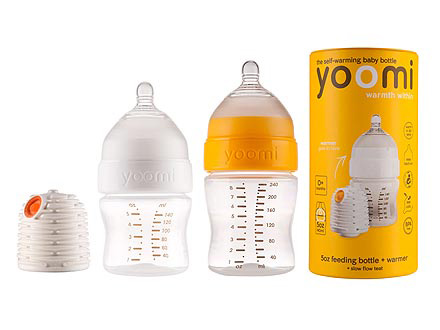
Then I came across what seemed to be just what I was looking for. The yoomi self-warming bottles.
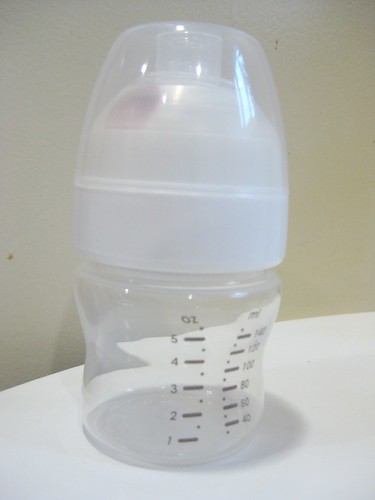
The brainchild of husband and wife team Jim and Farah Shaikh, it is a self-warming baby bottle system that features breakthrough technology to warm up milk directly in the bottle to the ideal temperature for the baby. It’s already a hit in the U.K. where it was introduced, and was just made available to the US market last month. With yoomi, you don’t have to worry about overheating or losing valuable nutrients, and the best part about it is that once you push the button on the warmer, it only takes 60 seconds to safely warm up the milk so that baby can feed right away!
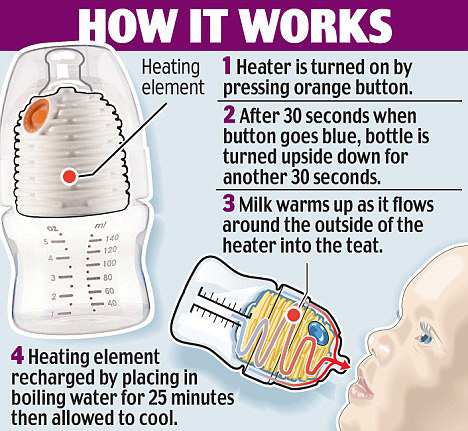
Here’s an illustration of how it works:
The cold milk flows through the heated warmer channels that is lodged in the teat, thus heating the milk inside to the appropriate temperature (86 to 90°F, or 32 to 34°C), never too hot or too cold.
The only aspects that are possibly inconvenient are the fact that the warmer unit needs to be recharged by being boiled in water for 25 minutes after each use before it can be used again, and the fact that after being recharged and used 100 times, it needs to be replaced. But honestly, if you are only using these bottles for when you go out or travel, it’s small potatoes in the grand scheme of things since you’ll only have to use them once in a while. And once you recharge the warmer unit, it’ll remain recharged almost indefinitely and will be ready for use at any time.
Also, based on some articles I read while doing my research on the yoomi bottles, they are developing a new warmer unit that can be recharged in the microwave for two minutes, for those who don’t want to deal with the 25-minute boiling sessions anymore. It’s slated for release later this summer. (I have my eye on it already!)
The bottles are BPA-free and ergonomically designed, and the wide silicone nipple mimics the mother’s breast. The well-placed vents in the nipple also prevent air from bubbling to help reduce colic (which is important to us, since that is why we use the Dr. Brown’s bottles at home).
Below is a video on how it is prepared and used for the first time:
After reading about this self-warming bottle system and doing all my research on it, I was sold. I ordered two 5 oz bottles with two warmer units, along with two 8 oz bottles for when Mio starts drinking more in the months to come. They got here relatively quickly!
yoomi bottles upon arrival. Love the cool packaging! (Reminds me of Packaging Design class from college...)
Very unique, wide bottle design.
The warmer unit with the button inside the teat.
5 oz and 8 oz bottles from yoomi
We tried the yoomi bottle out on Mio this weekend while we were out, and we’re happy to report that she drank from it just fine! 🙂 (Because as cool as the technology may be, it won’t be any good if our baby refused to drink from the bottle.) I was so excited!!!
Mio drank the bottle dry!
She's starting to put her hand on the bottle... she might even start holding it up herself soon!
So far, we’re very impressed by the yoomi bottle and can’t get over how cool the technology is! I feel a lot better about my upcoming flight back East, now that I have these bottles with me…. Going out and about Mio is going to be a lot easier now.
Every once in a while, a revolutionary baby product hits the market and changes everything. I’d have to say that this is absolutely one of those products. I would definitely recommend this for on-the-go parents with babies!
We watched a documentary film the other night, and our minds were changed forever. The Business of Being Born had actually been recommended to me by multiple friends and acquaintances, so I was curious to see what all the fuss was about. Dan and I are so glad that we had the opportunity to watch this movie before we set foot in the hospital for labor and delivery in a few weeks. It was a true eye-opener and I feel strongly that every woman who is expecting, as well as every woman who plans on giving birth someday, should watch it.
Produced by Ricki Lake, the documentary explores the contemporary experience of childbirth in the United States and turns a critical eye to the American health care system which emphasizes drugs and costly interventions, often at the expense of the best possible outcome for mothers and their babies. The film has an obvious bias in that it documents several home birth experiences assisted by midwives and shows them in a much more positive light than hospital births in which mothers are riddled with drugs and various forms of intervention. It’s a very clearly anti-hospital perspective, but the documentary does put forth a strong argument with very solid facts and supporting evidence:
The U.S. stands alone in the developed world in its physician-driven birth system — midwives attend over 70% of the births in Europe and Japan, versus 8% in the U.S. While the U.S. spends twice as much money per birth as any other country, it has the second worst newborn death rate and one of the highest maternal mortality rates among developed nations.
The film points out that the medical industry has convinced the majority of American women that they “don’t know how to birth,” creating a culture of fear — hence why women these days are so afraid of birth and the pain associated with it that they will cling to anything that helps diminish that fear, including pain medication and all sorts of intervention. In the past few decades, there has been alarming increase in the number of women who have Caesarean sections, with the most recent statistic showing that C-sections make up a third of of all births in this country. While in some cases, C-sections are necessary due to any of a number of possible complications, the reality is that most of them are unnecessary and could have been prevented. OBs are basically surgeons, and since they are often more knowledgeable about surgery than natural birth, C-sections are an easy way for them to speed up the delivery process and get the mother and baby in and out of the hospital as fast as possible. Litigation concerns also drive doctors to perform C-sections as soon as the slightest complication surfaces. These days in the U.S., childbirth is treated as a medical emergency rather than a natural occurrence.
The above clip from the documentary in particular stuck in my mind: it shows how the use of one drug can lead to another, and yet another… creating an inevitable domino effect. Pitocin is very commonly used to increase the intensity and frequency of contractions. This also means increased pain for the laboring mother, which often leads to her getting an epidural anesthetic to help alleviate the pain. But the epidural often slows labor, leading to a perceived need for more pitocin; this cycle of pitocin and epidural (along with any of a number of other drugs) may well continue until the baby’s blood and oxygen flow is compromised, leading to an emergency C-section. The doctor is then credited with saving the mother and baby, when the domino effect of all these intervention drugs may have been what actually contributed to or caused the emergency.
Overall, I thought it was a very powerful documentary, and it was really well put together, interviewing several women and documenting a number of births. It also gives a brief background of the history of birth in America, and how the medical industry has changed the childbirth experience within the past century. You can see the full trailer below.
On a personal level, Dan and I were really forced to rethink our birth plan after watching this film. After reading all my pregnancy books and listening to the labor and delivery experience from other mothers, I had kind of accepted without question that I would get an epidural and whatever other pain relief medication when it came time to deliver my baby — it just seemed like it was what all women did. I never really thought about all of the adverse consequences that may come about from going along with all of those intervention measures that the hospital throws at you. Isn’t it funny that we as Americans spend so much time researching certain things, such as what latest camera to purchase, but don’t give nearly as much thought and consideration to how we give birth to our children?
For us, it was a real wakeup call and we have decided that we are going to try as much as possible to have a natural birth. But before I go further into the reasoning of why, I want to preface this by saying that I absolutely do not think that not having a natural birth makes a person any less of a woman or a mother than one who does. In the same vein, I know I need to be realistic and be aware that you can go into labor with your heart set on a natural birth, but end up needing medical intervention or even an emergency C-section if a truly severe complication arises. My mother went to Lamaze classes throughout her first pregnancy when I was in her belly, preparing to have a natural birth, but ended up with preeclampsia (high blood pressure during pregnancy) and had to schedule an emergency C-section before my due date even came around. Due to the nature of C-sections performed back then, VBACs (vaginal birth after C-section) were not an option for her and she had to have all three of her subsequent children by scheduled C-sections as well — and she is the best mother I could have ever wished for, and I admire and respect her.
But I can’t help but feel that there is something inherently wrong with the picture when I see expectant mothers talking about how they will absolutely be getting that epidural when it comes time for them to go to the hospital. How can you be so sure that it will be necessary when you aren’t even in labor yet? Are you just planning on getting it because the hospital advises that you should? I feel like when you go into labor requesting all these drugs and medical intervention at the outset, you’re already setting yourself up to fight an uphill battle in terms of having a regular vaginal birth. You’re not even supposed to get an epidural until you are at least 5cm dilated, but not all hospitals abide by this rule and I’ve heard stories of women who had the epidural administered prematurely and they ultimately ended up in the operation room for an emergency C-section. (According to a statistic I read, getting an epidural any time before you are 5cm dilated triples your odds of needing a C-section.) A lot of people forget that C-sections are major surgery, and while hospitals have a lot of experience with them (apparently moreso than with natural births these days), it still poses a danger to both mother and baby and should be avoided in favor of a regular vaginal birth, unless absolutely necessary. Having a C-section also interrupts the release of oxytocin, a hormone that is released in natural childbirth which helps trigger an immediate bond with your baby and also stimulates breastfeeding. As I mentioned above, my mother had a C-section for all four of her children, so in the back of my head, I’ve always been aware that it could be a possibility for when I have a baby — but I’d like to avoid it if at all possible.
Another point that the documentary only briefly mentioned — that Dan and I ended up discussing further in detail afterwards — is that the rise in the use of these intervention drugs coincides with the rise in cases of ADHD and autism in children in the past few decades. There’s no real evidence that shows a direct link between the two yet, so it could be purely coincidental and more due to the fact that more and more women are giving birth when they are older… but we were discussing how we honestly wouldn’t be surprised if in the future, they find that there’s a direct correlation between such disorders and medicated births.
I know that this is starting to sound very anti-medical establishment and I’m making hospitals look like the “bad guys” for pushing interventions on women, but this is not the case. I have a lot of respect for the doctors and nurses that work in the labor & delivery units in hospitals (I know a few myself), and I think it’s amazing how every day they assist in bringing new lives into the world. I’m grateful that we live in a time when we’re equipped with more knowledge and medical advancements than ever to safely deliver babies, and thank goodness for the doctors who know how to administer an intervention when there are emergency situations that necessitate one. While The Business of Being Born seems to push home births, I personally don’t think I could ever do a home birth — I’m too paranoid that something will go wrong, and a home birth is just in general a little too New Age for me. I will likely always rely on a hospital for labor and delivery (although I may consider a birthing center in the future), and it would be silly of me to bash them when I am going to be completely in their care.
I do think it’s important, however, to find a hospital that is respectful and supportive of your birthing plan. Thankfully, the hospital we plan to deliver at is Kaiser Walnut Creek, which has a very progressive midwifery program; Kaiser hospitals in the Bay Area are known in general to set the standard for other Kaiser branches around the country, so we are pretty confident that we are in good hands. The hospital will assign us a midwife when we arrive to deliver, and an OB will only be brought in if there’s a complication or we request it. Kaiser Walnut Creek has a low C-section rate, and are known to be pro-natural birth and I’ve heard that they let you labor and push at your own pace, without trying to rush you with drugs and intervention. It’s such a relief to know that they will respect our hopes to have as natural a birth as possible, so that we won’t have to expend our energy putting up a fight in the eleventh hour.
We were able to conceive this baby without intervention, and she has been growing healthy and strong the past eight months in the womb without intervention, so it only makes sense that the best way for her to come into this world would be without unnatural intervention. Again, I know that there are so many unpredictable and unknown factors that may come into play in the delivery of our child, and although I may dream of a natural birth, I’m not necessarily going to get what I want when the time comes. I know I need to prepare myself for such circumstances, and if it truly comes down to a life-threatening situation for the baby, I will of course gratefully accept medical intervention. But with nearly 33% of women delivering their babies by C-section today (compared to the less than 5% back in 1965), I can’t help but question how many of those were truly unavoidable and how much of the intervention that is pushed onto mothers is really necessary.  I know that labor and delivery will be the most difficult, painful, and challenging experience I’ve encountered yet, but I just want to make sure that we’ve done as much as possible to have our ducks in a row to make it as smooth, healthy, and safe a delivery for both myself and for our daughter.



 The brainchild of husband and wife team Jim and Farah Shaikh, it is a self-warming baby bottle system that features breakthrough technology to warm up milk directly in the bottle to the ideal temperature for the baby. It’s already a hit in the U.K. where it was introduced, and was just made available to the US market last month. With yoomi, you don’t have to worry about overheating or losing valuable nutrients, and the best part about it is that once you push the button on the warmer, it only takes 60 seconds to safely warm up the milk so that baby can feed right away!