We don’t have stairs at our home back in California, but the rooms we’re staying in at my parents’ house is on the second floor. Since the first day we got to Virginia, Mio has been a pro at climbing the stairs, despite not having had any stairs to practice on in the past. I guess all the table-climbing made her a natural at tackling stairs… Of course, I always hover from behind to spot her and make sure she doesn’t tumble down. Here’s a video I took! (In retrospect, it probably would have been better to have it taken from the front, so you could see her face, but instead you get plenty of baby butt footage. Oh well… next time!)
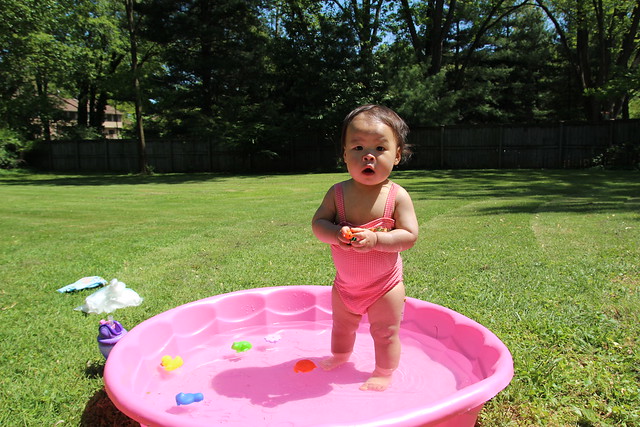
As it is with a lot of grandparents, my mom has a tendency to want to pamper her grandchild, and she always insists on buying babygear and toys for Mio that she can use while in Virginia, even though we’re rarely here for over two weeks at a time. (We already have a separate car seat, high chair, and travel crib that will always be waiting for us in Virginia… I do admit that it makes our life a whole lot easier!) She went out for a shopping run yesterday morning and came back with a baby pool! Because it was very sunny and the perfect weather for some splashing around, we took it out to the backyard for Mio to play in it. This was Mio’s first experience with any sort of pool, as where we live in Northern California rarely gets hot enough to be pool weather, so it was pretty exciting!
No diving in the baby pool! You don't say...
Mio testing the water. (My mom bought her some pool/bath toys, too!)
Mio was at first a little stunned...
Obaachan blowing bubbles for Mio
Mio eventually squatted down to sit in the pool.
Pooltime in the backyard
It was the perfect weather for some fun in the sun!
Three generations of Yokoyama ladies!
Having a blast.
I kept putting hats on her, but Mio pulled all of them off and into the water... 🙁
Mio had so much fun, we had a hard time getting her out of the pool!
Here’s a video I took of the pooltime fun!
Hopefully we’ll get several more uses of the baby pool during our stay here in Virginia! Mio has always loved the water (she relishes bathtime), so I can see this pool becoming very addictive for her. 😛
I remember spending many of my summer days as a young child playing in a kiddie pool of our own in the same backyard with my siblings, and I can’t help but smile as I think back on all the fun we had. One of the best parts of becoming a parent is how we are given the opportunity to be a kid again — to relive the best of our childhood memories all over again, except this time with a deeper understanding of just how precious those moments are. I hope that someday, Mio will look back on all those happy moments we’ll share with the same fondness and smile.
I know I post almost every day about Mio, and most of you must be sick of hearing about her and seeing her… but she is constantly doing such interesting new things these days that I want to record it here, at least so that we can remember it ourselves. And of course, to show our doting family members who are too far away to see Mio all the time.
So here I am, sharing yet another video clip of our daughter. Lately, she likes to bring over items and hand them to us, and enjoys hearing us say “thank you, or when I speak Japanese to her, “arigato.” She often reacts to our thanks by lowering her head and burrowing her face in her hands in an “aww shucks” sort of way, as if she’s being bashful. We tried to capture it on video, but this time she ended up doing more of a bow of acknowledgment, as if to say “you’re welcome.” (I’m speaking to her in Japanese in the video, but the words are simple enough and you can get the general gist of what’s going on.) Without further ado, here’s yet another daily dose of Mio!
As you can observe in the video, Mio has learned how to climb up onto the coffee table. She’s done it at least a dozen times since yesterday. No matter how many times I pull her off or try to navigate her away, she goes right back to it.
I’d heard toddlers usually begin climbing between 18 to 24 months, but Mio has once again surprised us with her advanced athletic abilities. And she looks so pleased with herself every time, too. Heaven help us….
We’ve been teaching Mio some basic ASL as “baby sign language” to help her communicate to us what she has yet to be able to say verbally. We started by signing only a couple signs to her six months ago, and for the first few months, it felt like she wasn’t comprehending much because she’d just respond with a blank stare. But all the consistency paid off, as she’s really been picking up the words in the past two months. She now knows how to sign “milk,” “more/again,” “eat,” “bath,” “shoes,” and “all done.” She’s also starting to understand the signs for “dog,” “hurt,” and “delicious,” but doesn’t sign them quite as readily yet. I’ve been trying to stay ahead of her by learning more signs myself to teach her, but my brain is not the absorbent language sponge it used to be! But I’m trying my darnedest to remember more and use signs as much as I can in conversations with Mio.
I was randomly browsing the web when I came across a very interesting article that explains the benefits of teaching and using baby sign language in a bilingual household. When each parent uses the sign and says the words in their respective language, sign language becomes a “language bridge” between the two languages to connect the words together for the child to understand that they have the same meaning. The article explains it best:
Excerpted from The Baby Signs® Program: A Helpful Tool in Bilingual Settings
Linda Acredolo, Ph.D. & Susan Goodwyn, Ph,.D.,
Co-Founders, Baby Signs, Inc.
As more and more parents learn the value of exposing their children to second and even third languages early in life, the number of babies being raised in “bilingual homes†is rapidly increasing. Just what does this mean? In many cases it means that one parent speaks one language to the child while the other parent speaks a second. In other cases, both parents may speak the same language to the child while a trusted caregiver (grandmother or nanny) speaks another.
So, what happens if we add signing to the mix? Will it just add to the child’s confusion?
The answer is a strong and resounding “No!†The truth is that, no matter what form bilingual input takes, adding signing to the mix actually makes the child’s job easier, not harder. Here’s why.
When children first start learning about language, they quite naturally look for one-to-one correspondences between words and the objects (or actions) they label. For example, babies in an English-only environment, upon hearing the word “milk†in the presence of white stuff in their bottle, will eventually learn to associate the two together:
CHILD: “Hmmm….I get it! The white stuff in my bottle = ‘milk’“
However, life gets more complicated in a bilingual household. In this case babies consistently hear two words in association with the white stuff in their bottle, a situation which can be very confusing.
CHILD: “Hmmm….Sometimes I hear “milk,†sometimes “leche.†What’s going on?â€
Clearly, what children hearing two languages need to figure out is that both words are equally important labels for milk. And that’s where signing comes to the rescue. By adding a sign to the mix so that the same visual symbol (sign) accompanies both words (“milk†and “lecheâ€), parents make the job of connecting the object with the meanings of both words much easier for babies. In other words, when the baby hears “leche†paired with sign and then also hears “milk†paired with the sign, the pieces fall into place:
CHILD: “Aha! These words mean the same thing!
In summary, rather than confusing your bilingual child, signs will help smooth the road to understanding and speaking both languages.
Of course, signing has another advantage in bilingual settings, especially in child care classrooms where teachers and families speak different languages: The signs provide a common language so that toddlers who are learning the family language can still make themselves understood. Just such a situation exists at the Center for Child and Family Studies at the University of California, Davis, where graduate students from all over the world routinely enroll their infants and toddlers. In the 18 years since the Baby Signs® Program was first introduced, teachers and parents alike have been amazed at how much more smoothly daily life in the classroom proceeds, with data specifically showing that the teachers are more responsive to the needs of the children. In addition, the signs have enabled children who speak different languages to communicate with each other. In one case, for example, a toddler from Israel and a toddler from Taiwan were observed reading a picture book together—with the first girl turning the pages and pointing at objects while the second girl made the appropriate signs!
Bottom line? Signing is clearly a boon to children facing the challenge of hearing multiple languages, whether at home or in the classroom.
Very cool! And the most awesome part for us is that we had already unconsciously been practicing this — Dan always uses the English words while signing, while I always use the Japanese word for it while using the same sign. For example, Dan says “more,” while I say “motto,” when we use the ASL sign for “more,” and Mio has been responding to the word in both languages with the same sign. We even have it on video from a couple weeks ago!
With this new knowledge and perspective on baby sign language, we are more convinced than ever that it is a valuable tool for the development of Mio’s communication skills and our efforts to raise her to become a bilingual speaker.